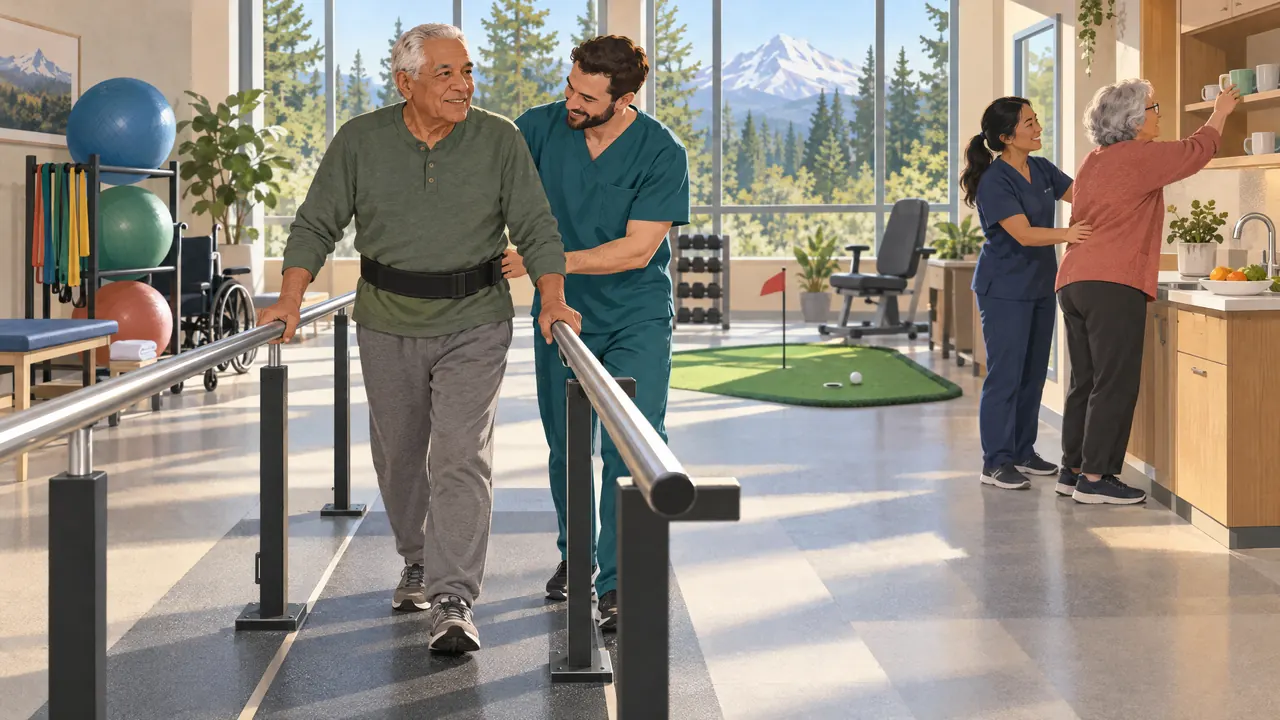
After a hospital stay, you may be ready to leave the hospital but still need help walking, managing daily tasks or receiving nursing care. At Shuksan Healthcare Center in Bellingham, our short term rehabilitation combines in-house therapy with around-the-clock nursing care to support your recovery and prepare for what comes next.
You don’t have to have every answer before you call. Knowing what help you need now, and what you hope to return to, gives you a useful starting point for discussing rehabilitation with your family and care team.
What does a short term rehabilitation stay involve?
Say your father is leaving the hospital after a hip replacement. He can get out of bed with help, but he isn’t ready to manage the bathroom or stairs at home. You may be asking, “What happens between leaving the hospital and coming home?”
At Shuksan Healthcare Center, we offer short-term rehabilitation after hospitalization in a 52-bed skilled nursing facility. Our in-house rehabilitation team includes physical therapists, occupational therapists and speech therapists, with respiratory therapists available as needed. We also have a rehabilitation center and therapy gym.
Different therapies address different needs:
- Physical therapy focuses on movement, strength, balance and mobility.
- Occupational therapy addresses everyday tasks, such as dressing and using the bathroom.
- Speech therapy may address communication, thinking skills or swallowing needs.
Your care needs determine which services are appropriate. There isn’t one fixed schedule or length of stay for everyone.
Before a transfer, ask the hospital’s discharge planner, the person helping coordinate care after hospitalization, to explain the recommended therapies, nursing needs and equipment. Bring that information to your conversations with a rehabilitation facility. It helps everyone start with the same picture.
How do we set goals that matter to you?
Say your mother wants to return home, but her most immediate concern is being able to tend her flowers again. “Getting stronger” matters, yet it may feel too broad to guide her day-to-day work.
Our therapy plans are personal and built around what each person enjoys or needs to return to. Our therapists have used goals such as throwing a ball for a dog, tending flowers in the courtyard and practicing putting. These activities connect rehabilitation to familiar movements and meaningful routines.
The everyday details matter. Reaching for a flowerpot, standing at a counter or moving from a chair can help clarify what needs practice.
Before admission, write down a few priorities:
- What do you need to do safely at home?
- Which activities do you most want to resume?
- What could you do independently before the hospital stay?
- Where did you already need help?
Share both hopes and concerns. A clear starting point helps the therapy team discuss realistic goals without promising a particular result or recovery date.
What if you still need nursing care?
Say your spouse needs therapy after surgery but also has a wound that requires ongoing treatment. You’re wondering whether rehabilitation can happen while those medical needs are being addressed.
Our licensed nurses and nursing assistants provide nursing care around the clock. Our nursing services include medication management, oxygen therapy, diabetes management, IV medications and tracheostomy care. We also provide wound care, including negative-pressure wound therapy, often called a wound vac, with consulting nurses for complex wounds.
Before choosing a facility, ask the hospital team for a current medication list and a written description of treatments. Then confirm that the receiving facility can meet those specific needs.
Don’t rely on a general description alone. Explaining the treatment, equipment and assistance required helps the team assess whether the setting is appropriate.
How can your family help during recovery?
Say your father tells you therapy went well, but you’re unsure how much help he still needs getting into a car. You want to encourage him without asking him to do something unsafe.
Families are welcome and encouraged to be involved at Shuksan Healthcare Center. Our social services team helps arrange care plan conferences, meetings where families and the care team discuss needs, goals and next steps.
Bring questions to those conversations. Ask what your family member can do independently, what still requires assistance and what you should practice together. Our therapists can train family members on car transfers, which can make the instructions easier to understand and use.
Share useful details, too: the height of the bed at home, bathroom access or who will be available to help. And ask before assisting with unfamiliar movements.
Family involvement isn’t about doing everything. It’s about learning how to offer the right help while leaving room for your loved one to participate.
Prepare the home before discharge
Say your mother is making progress with a walker, but her home has loose rugs and a narrow path between the couch and coffee table. Being ready for discharge means considering the space she’ll return to, not just her progress in therapy.
The CDC reports that about 1 in 4 adults aged 65 and older falls each year. That makes a home safety review a practical part of planning.
Our therapists can perform a home safety assessment before discharge. To prepare for that discussion:
- Describe steps, handrails and the route from the entrance to the bedroom and bathroom.
- Ask about walking paths, lighting and loose rugs.
- Review bathroom equipment and where assistance may be needed.
- Confirm who will help with meals, medications and transportation.
Ask before buying equipment. Recommendations should reflect the person’s abilities and home setup.
Our social services team can help arrange home health after discharge and connect you with community resources. We also have a wheelchair-accessible van for medical appointments, and therapists can accompany residents to appointments when needed. Discuss follow-up plans early so responsibilities are clear.
Will Medicare cover short-term rehabilitation?
Say your spouse has Medicare and is leaving the hospital. You may assume rehabilitation is covered automatically, but eligibility depends on specific conditions.
According to Medicare.gov/CMS for 2026, Medicare Part A covers skilled nursing facility care after a qualifying inpatient hospital stay of at least three days when a doctor orders daily skilled care. Time spent under observation doesn’t count toward those three days.
A skilled need means care requiring qualified nursing or therapy professionals. Medicare doesn’t cover long-term custodial care.
For covered care in 2026, days 1–20 of a benefit period, Medicare’s coverage counting period, have $0 coinsurance; days 21–100 have $217 daily coinsurance. After day 100, the patient pays all costs.
Ask the hospital to confirm inpatient status, then review coverage questions through admissions. For insurance questions or current bed availability, call (360) 733-9161.
A useful next step is to discuss your recovery needs
Say you’re comparing facilities before a hospital discharge. Start with the needs that must be met: required treatments, recommended therapies, help with daily tasks and the home you hope to return to.
We can discuss rehabilitation at Shuksan Healthcare Center and answer questions about admission. Have the hospital’s recommendations and your questions nearby when you call (360) 733-9161, or visit us at 1530 James Street, Bellingham, WA 98225, in the York neighborhood.
Frequently asked questions
What happens during short term rehabilitation after a hospital stay?
At Shuksan Healthcare Center, short-term rehabilitation combines in-house therapy with around-the-clock nursing care. The rehabilitation team includes physical, occupational and speech therapists, with respiratory therapists available as needed. Care needs determine the services, and there is no fixed schedule or length of stay for everyone.
Can my family member receive wound care during rehabilitation?
Shuksan Healthcare Center provides wound care, including negative-pressure wound therapy, with consulting nurses for complex wounds. Licensed nurses and nursing assistants provide care around the clock. Before transfer, families should confirm that the facility can meet their loved one’s specific treatment and equipment needs.
Does Medicare cover short term rehabilitation after hospitalization?
According to Medicare.gov/CMS for 2026, Medicare Part A covers skilled nursing facility care after a qualifying inpatient hospital stay of at least three days when a doctor orders daily skilled care. Observation time does not count toward those three days. For covered care, days 1–20 of a benefit period have $0 coinsurance, days 21–100 have $217 daily coinsurance, and patients pay all costs after day 100.